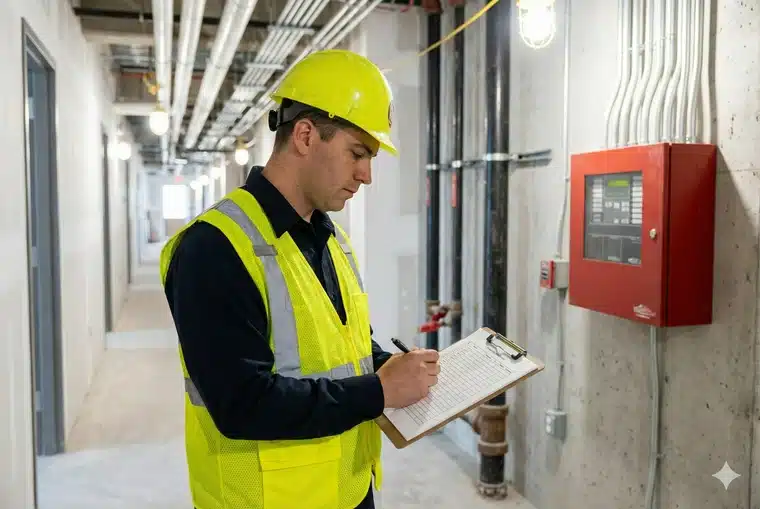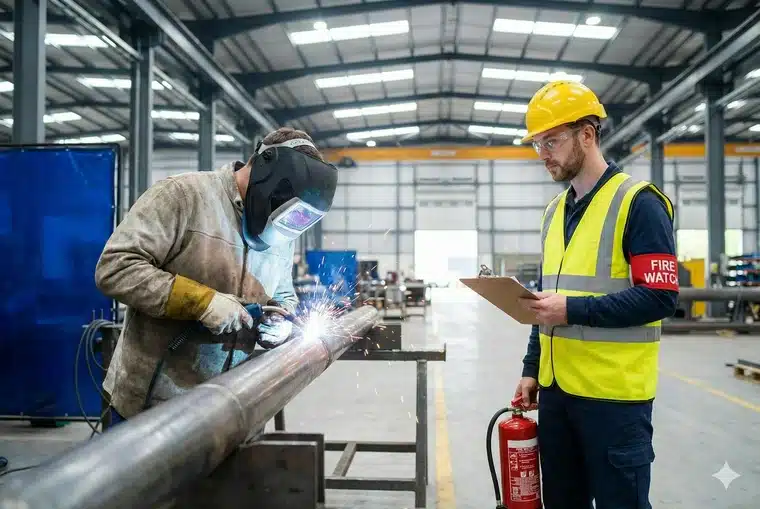
Construction sites face fire risk from the moment the first crew walks in. Hot work, temporary wiring, stored fuels, and exposed framing all raise the chance of ignition. This is why fire watch coverage is so important on active builds. When done right, it protects workers, prevents costly delays, and keeps you aligned with safety rules and insurer requirements.
This guide explains how fire watch works on construction projects, when it becomes mandatory, what duties the guard handles, and how it keeps your project on schedule.
Why Construction Sites Carry Higher Fire Risk

Construction brings hazards that you won’t find in a finished building. Each phase of the project introduces new ignition points, like:
• Hot work on active structures — Welding, cutting, brazing, and grinding can throw sparks far beyond the immediate work area.
• Temporary electrical runs — Extension cords, open panels, exposed cables, and generators create heat and overload risk.
• Exposed framing and insulation — Wood framing, vapor barriers, and foam insulation ignite faster than finished walls.
• Stored flammables — Solvents, lumber, adhesives, fuel containers, and roofing materials stay on-site throughout the build.
• Dust and debris — Construction dust settles in framing cavities and can smolder if sparks land in the wrong place.
• Heavy subcontractor activity — Multiple trades working at the same time increases the chance of small hazards going unnoticed.
• Limited suppression systems — Sprinklers and standpipes often come online late in the build, leaving no automatic protection early on.
These conditions make fire watch an important control measure for general contractors who want to keep the site safe and the project moving.
What Fire Watch Means on a Construction Site

A fire watch on a jobsite is not the same as having a regular security guard conduct patrols. A fire watch guard is trained to monitor active work zones, identify ignition sources, and respond fast if a hazard arises.
On construction sites, fire watch often covers:
✔️Hot work areas
✔️High-risk zones during after-hours periods
✔️Temporary electrical setups
✔️Material storage areas with flammables
✔️Spaces where sparks or heat can travel
The guard’s focus is on fire prevention and hazard detection. They do not watch for theft or manage site access. Their responsibility is to monitor risk areas and report hazards before a fire develops.
Fire watch helps the GC, the safety manager, and the trades working on-site because it adds a layer of oversight when conditions are unpredictable.
When Fire Watch Is Required on a Construction Project
You need a fire watch when the site has conditions that make fire easier to start or harder to catch. Here are the most common situations when it becomes necessary:
- During any hot work: Welding, cutting, soldering, grinding, or torch operations, send sparks into nearby materials.
- When temporary wiring or generators introduce ignition risk: Loose connections, overloading, or exposed wiring can cause overheating.
- When suppression systems are not yet active: If sprinklers, standpipes, or alarms are offline or not installed, manual oversight is required.
- When flammables stay on-site: Fuel cans, adhesives, roofing tar, and solvents make early-stage construction more vulnerable.
- During after-hours periods: When no crews are present, hazards can grow unnoticed.
- When required by insurers or the Fire Marshal: Some projects demand fire watch as part of the insurance binder or local fire code.
- After an incident involving heat or an electrical malfunction: Even if the fire was small, a guard stays in place until all hazards clear.
Fire watch fills the gaps that arise during active construction. If your site cannot be fully controlled, monitored, or protected, hiring a trained guard is highly recommended.
Key Duties of a Construction Fire Watch Guard
On a construction site, the guard’s duties focus on hazard detection, documentation, and immediate response. Their work protects the project, the crews, and your compliance record.

Here is what a trained construction fire watch handles:
✔️Walks active work zones and checks for ignition sources: They look at areas where sparks, heat, or friction can cause trouble.
✔️Monitors hot-work areas before, during, and after the operation: They stay close to welding, cutting, or grinding activity and keep watch as materials cool.
✔️Checks temporary electrical lines, panels, and cords: Loose runs or overloaded circuits often cause early-stage fires.
✔️Watches for smoldering debris in framing or insulation: Fire can hide in walls, gaps, or cavities. Early detection stops it from spreading.
✔️Keeps flammables under control: Guards make sure containers are sealed, stored correctly, and placed away from heat.
✔️Maintains time-stamped logs: These records help you satisfy inspectors, fire officials, and insurers.
✔️Alerts site supervisors to unsafe conditions: If something looks wrong, the guard notifies the GC or safety lead right away.
✔️Calls emergency services if a fire begins: Fast reporting prevents small hazards from turning into losses.
✔️ Remains on-site until all fire risks clear: Construction hot spots can reignite, so they do not leave early.
How Fire Watch Helps Prevent Delays & Protect Your Project Timeline
General contractors know how easily delays stack up. Fire watch coverage helps protect the schedule by reducing problems that slow the job down.
Fire watch prevents:
- Failed inspections: If a Fire Marshal finds unsafe hot-work activity, missing fire logs, or poor hazard control, they can stop the job.
- Insurance disputes: Insurers want proof that hazards were monitored. Fire watch logs keep the claim process smooth.
- Project shutdowns: Local officials can shut down areas that lack proper oversight.
- Material loss: A small smolder behind framing can ruin lumber, tools, wiring, and insulation.
- Red-tagged areas: If an area fails inspection, work cannot resume until hazards are resolved.
- Costly rework: Even small fires lead to repairs that push the schedule back.
- After-hours surprises: Unattended sparks or overheated equipment can ignite long after crews have left.
With trained fire watch coverage, you reduce the chance of hazards expanding into delays. This keeps subcontractors working, keeps the schedule intact, and protects the GC from avoidable setbacks.
Fire Watch vs Standard Security Guard: What’s the Difference?

A security guard and a fire watch guard do not serve the same purpose. Here’s how their roles differ:
| Fire Watch Guard | Security Guard |
| Watches for sparks, heat, smoldering, or unsafe conditions | Watches for theft or damage |
| Monitors hot work such as welding, cutting, or grinding | Monitors entry points and patrol routes |
| Checks temporary wiring, fuel storage, and flammables | Manages site access and checks credentials |
| Keeps detailed fire logs for inspectors and insurers | Documents general site activity |
| Trained in fire risk, hazard spotting, and fast response | Trained mainly in security and loss prevention |
| Calls emergency services at the first sign of ignition | Calls in security issues or trespassers |
| Stays close to active work zones | Covers wide areas of the site |
👉Note: Security guards do not meet OSHA or Fire Marshal expectations for fire safety oversight. This is why general contractors cannot rely on security to perform fire watch duties unless they are trained for the role and meet all requirements.
What Insurers Expect During Construction Fire Watch
Insurance companies have their own rules for construction risk. When they require fire watch, they expect clear, complete, and accurate records.
Insurers often ask for:
✔️Active, time-stamped fire watch logs
✔️Evidence that patrols covered all zones
✔️Verification that hot work was monitored
✔️Proof that flammables were managed safely
✔️Confirmation that suppression equipment was available
✔️Clear reporting if hazards appeared during the shift
These records support your claim if anything happens and prove that you followed safety procedures.
Final Thoughts
Construction sites change every day, and with those changes come new fire hazards. Fire watch adds strong protection during hot work, high-risk tasks, and after-hours periods. It keeps the project on track, helps you pass inspections, and supports your insurer’s safety requirements.
If you need trained fire watch guards who understand construction hazards and respond fast, Fast Fire Watch Guards is here to support your site. You can request a quote whenever you need coverage for hot work, temporary wiring, material storage, or overnight monitoring.