
Fire Watch Guard Services in Boise, ID
The Fast Fire Watch Company is a firefighter-run fire watch company protecting Boise with NFPA- and OSHA-compliant guards. When your sprinklers or fire alarm go offline, or hot work puts your site at risk, we get a licensed Boise fire watch guard on site in under three hours, every time.
You get the best rates and the best customer service in Boise fire watch: no long-term contract, GPS-tracked patrol logs your fire marshal will accept, and a real person on the phone any hour of any day. Call and we will confirm your guard and a start time on the spot.
✓ OSHA & NFPA Compliant ✓ Fire Watch Certified ✓ Bonded & Insured ✓ 24/7 Dispatch
Trusted by



A Complete Definition
What Is Fire Watch in Boise, ID?
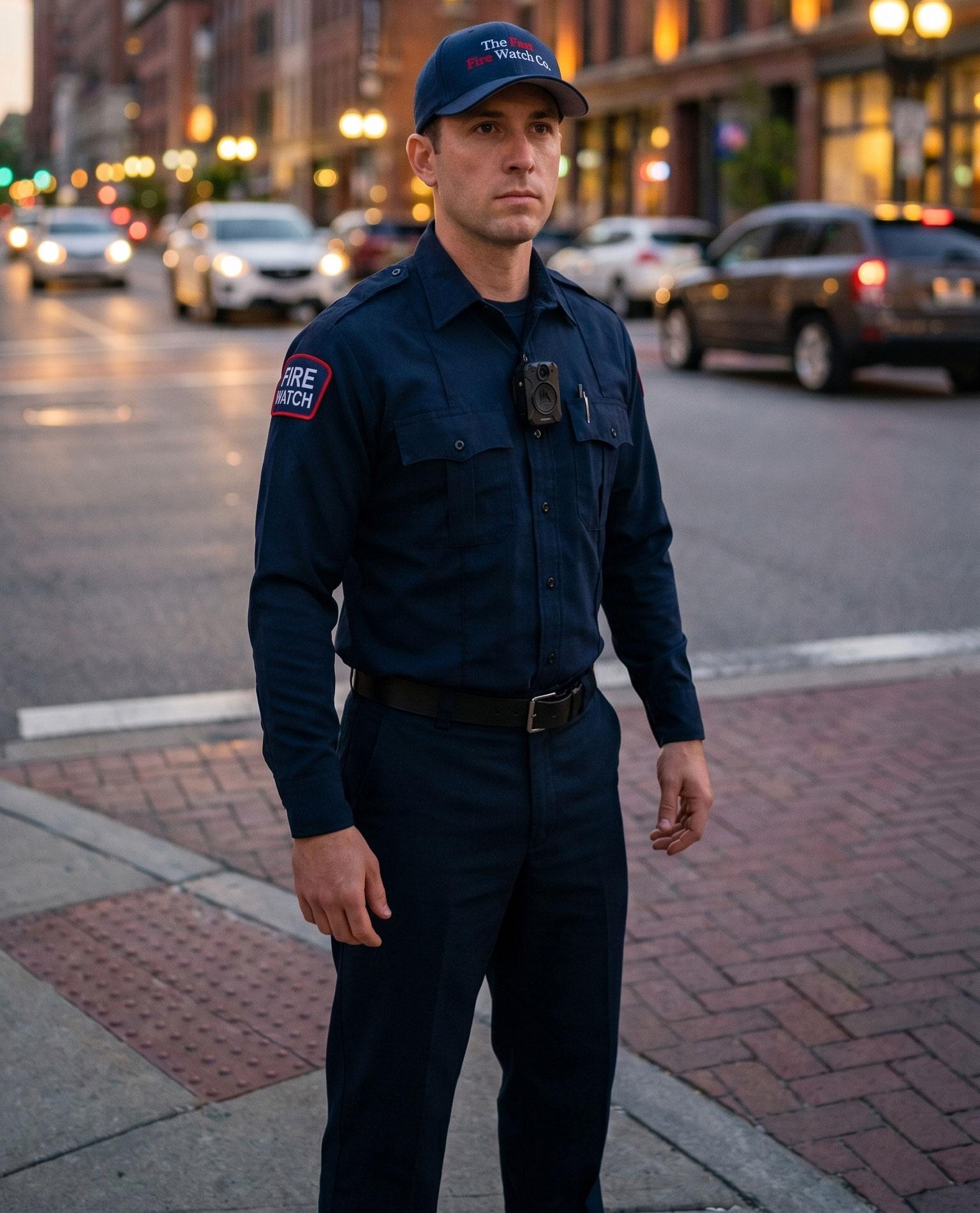
A fire watch in Boise is a trained guard who patrols your property on a set route while fire protection is down or hot work is underway, watching for fire and calling 911 the moment it starts. We provide that guard ourselves, drawn from teams already working the Treasure Valley, so when an alarm panel faults in a downtown tower or a sprinkler riser drops offline in a warehouse near the airport, someone trained is walking your building, usually on site in under three hours.
Idaho calls for this coverage any time a building’s built-in protection is impaired, or while welding and other hot work send sparks near anything that burns. The Idaho Fire Code, based on the International Fire Code (IFC), enforced locally by the Boise Fire Department and backed by the Idaho State Fire Marshal, sets the rule. A guard holds the line and keeps your permit valid until repairs are done.
Not every one of the Fire Watch Companies in Boise staffs to that standard. We run continuous coverage with no gap between shifts and a documented log built for the inspector, across the downtown core and capitol complex, the Micron campus and the tech corridor, the university district, and the industrial blocks south of the river. Tell us the address and what needs watching, and a guard is on the way.
When Fire Watch Is Required in Boise
A Boise fire watch is typically triggered by one of six conditions:
- A fire alarm system is out of service for more than four hours within any 24-hour period (NFPA 72).
- A sprinkler system is impaired for more than ten hours within any 24-hour period (NFPA 25).
- Hot work (welding, cutting, brazing, grinding, torch-down roofing) is performed in or near combustible materials (NFPA 51B and OSHA 1910.252).
- Active construction is underway and permanent fire protection isn't yet operational (NFPA 241).
- A special event introduces temporary structures, increased occupancy, or pyrotechnics.
- A fire marshal has issued a violation that requires interim watch coverage until repairs are complete.
No two of these triggers run on the same clock. A hot work watch holds a different cooldown than an impaired alarm, a construction watch logs to a different program than a sprinkler shutdown, and the Boise Fire Department expects the right paperwork for whichever one applies. We staff guards who have stood every one of these watches across Ada County, which is how correction notices stay off your record and how sign-off comes faster.
Who in Boise Needs Fire Watch Services?
Building owners and managers call for a fire watch when the structure can no longer protect itself: office towers, retail centers, hotels, condos, hospitals, warehouses, and active job sites all qualify. A shut-down sprinkler riser, a faulted alarm panel, or an out-of-service standpipe leaves a building that cannot detect or suppress fire, and a guard walking a fixed route fills that gap until the system is back.
Around Boise, the calls come from welding and grinding crews on mixed-use builds downtown, from contractors mid-repair on alarm and sprinkler systems in the capitol district, from clean-room and fab work at Micron, and from managers whose riser cracked after a hard high-desert freeze. Each round gets logged with a time stamp and the guard’s name, so what you hand the Boise Fire Department on inspection is a clean, unbroken record.
The Cost of Skipping a Fire Watch in Boise
A red tag from the Boise Fire Department is what skipping a fire watch usually buys you, and it is the cheap part of the bill. Inspectors who find an impaired sprinkler or a dead alarm with nobody standing watch can write a violation, pull your certificate of occupancy, or freeze the job until a trained guard is on the property, and the re-inspection puts you at the back of the line. Tenants get displaced, schedules slip, and the daily fines run while you scramble to staff the coverage you should have had from the start.
Then there is the fire you never see coming. Sparks from cutting work can sit in a wall cavity and smolder twenty or thirty minutes after the crew clocks out, and a building with its suppression offline has no second chance once that ember catches. Insurers know the pattern cold. File a claim that traces back to a coverage gap the code required you to fill, and the carrier has its grounds to deny, leaving the owner to eat the structure loss, the lost business, and the liability. One guard on a documented route costs a rounding error against any of that.
Get a Fast Quote Now
"*" indicates required fields
What's Included with Every Fire Watch Patrol
Everyone asks about pricing and response time, and those matter. But the real product we deliver is documentation. Here’s what comes standard with every deployment.
GPS-tracked patrol log
Photo documentation
AHJ-compliant reporting
Certified and insured guards
Fire extinguisher on hand
Direct account manager
End-of-engagement compliance packet
How Much Does Fire Watch Cost in Boise, ID?
What you pay for a fire watch in Boise tracks the job in front of the guard, not a flat sticker price. A single overnight hot work hold at a downtown restaurant build-out is a different assignment from a multi-guard rotation covering a high-rise with its standpipe drained, or weeks of NFPA 241 coverage on a tech-campus expansion. A handful of factors move the rate, and here is what they are.
What Drives Fire Watch Staff Pricing
- Type of watch: a routine alarm-impairment patrol prices differently than fab hot work or assembly-occupancy coverage at a campus arena, which carry more risk and more documentation.
- Hour of the day: overnight, weekend, and holiday shifts run higher than a standard weekday window, since that is when most construction and fab work happens.
- Emergency versus booked ahead: a same-day call after an alarm panel fails costs more than coverage you schedule in advance around a planned sprinkler shutdown.
- Length of the engagement: a one-night watch sits at the top of the range, while a multi-week construction or retrofit job earns a lower sustained rate.
- Guard count: a small office may need one patrol officer, while a high-rise or a campus build can require several guards on rotation to hold every floor and laydown area.
Typical Fire Watch Guard Cost Range
Most scheduled Boise watches fall inside the standard hourly band quoted above, per guard, covering the bulk of impairment patrols, hot work holds, and construction coverage across the city. Same-day emergency dispatch after a system failure sits above that range because we are mobilizing a trained guard to your downtown or tech-corridor address on no notice. Long-running assignments pull the other way: a multi-week campus expansion or a fab build lands at a lower sustained rate than a single overnight shift. Call and we will price your specific watch before any guard rolls.
Get a Specific Quote
Call 1-800-899-7524 for a same-day quote, or use our online quote form. Our staffing team will confirm the impairment type, the AHJ, the deployment timeline, and the number of personnel required, then send a written quote with the exact fire watch hourly rate and the projected total for your engagement.
What Boise Fire Department Fire Prevention Bureau Requires
The Idaho Fire Code sets the baseline. The code that governs your watch is the Idaho Fire Code, the IFC adopted for use in the state, and the Boise Fire Department enforces it alongside the Idaho State Fire Marshal, building by building. Our guards patrol and document to that standard on every shift, not a generic one.
Hot work demands a watch under IFC Chapter 35 and NFPA 51B. Cutting, welding, and grinding require a dedicated guard for the duration of the job and for no less than 30 minutes after the last spark, per IFC 3504.2.1 through 3504.2.6. The guard holds a charged extinguisher and watches for the slow burn a crew breaking down its gear will miss.
Impaired suppression and detection fall under NFPA 25 and NFPA 72. Take a water-based system out for service under NFPA 25, or drop a fire alarm under NFPA 72, and a guard stands the watch until that system is tested, verified, and back in service.
The Boise AHJ sets your specific conditions. Patrol interval, log format, and watch duration come from the Boise Fire Department and the local fire marshal, and we work to their call so coverage holds up when the inspector arrives.
Closeout is signed and time-stamped. When the watch ends, you get a complete patrol log, signed and dated, that stands as proof the coverage ran unbroken from the first round to the last.
- Fire alarm system out of service longer than 4 hours in a 24-hour period (NFPA 72)
- Sprinkler system impairment longer than 10 hours in a 24-hour period (NFPA 25)
- Hot work in any occupied structure (NFPA 51B)
- Active construction sites without complete fire protection (NFPA 241)
- Special events with temporary structures or occupancy increases
- Fire marshal-issued violation requiring interim watch
How Fast Can You Be On-Site in Boise?
- Downtown Boise & the capitol district – under 60 minutes
- Greater Ada County and the Treasure Valley – under 90 minutes
- Meridian, Nampa, and Caldwell – under 2 hours
- Extended Idaho coverage area – under 3 hours
Services We Provide in Boise
- High-Rise Fire Watch – Dedicated patrols for downtown Boise towers and the capitol complex when standpipe or sprinkler systems are offline
- Corporate & Office Fire Watch – Discreet uniformed guards for Ada County commercial buildings during alarm panel or suppression outages
- Construction Site Fire Watch – Code-required coverage for active Boise job sites performing hot work or lacking completed suppression systems
- Hot Work Fire Watch – Continuous monitoring during and 30 min after welding, cutting, or grinding operations per IFC Chapter 35 and NFPA 51B
- Industrial & Warehouse Fire Watch – Patrol and monitoring for Boise fabs, distribution centers, and storage facilities along the airport and rail corridors
- Event & Venue Fire Watch – Trained guards for concerts, conventions, and gatherings at venues like Boise State University arenas and downtown halls
- Hospitality Fire Watch – Guest-facing patrols for Boise hotels and resorts during system impairments, keeping evacuations orderly
- Healthcare & Hospital Fire Watch – ILSM-compliant coverage for facilities like St. Luke's Boise Medical Center and Saint Alphonsus Regional Medical Center
Pour a foundation downtown or frame a mixed-use block near the river and the fire hazard arrives long before the building’s own protection does. That early window is where our Boise Fire Watch Services plug in on a job site. IFC Chapter 33 and NFPA 241 put a watch in play once temporary heat is running, hot work is active, combustibles are stacking up, or the standpipes and alarms are not yet energized, the exact conditions on every new high-rise, every tech-campus expansion, and every infill project across the fast-growing metro.
We run the building the way the trades do, floor by floor, sweeping for ignition sources left behind at shift change and logging each pass for the general contractor and the Boise Fire Department. Overnight, weekends, the dead hours after the last crew rolls out but the hazard stays put, that is when our guards are walking. Send us your construction schedule and your permit conditions and we will build the coverage to fit them.
Why Boise Fire Watch Demand Stays High
State capitol and downtown high-rise core. The capitol complex, the government office buildings, and the downtown towers pack dense occupancy, where one alarm fault or a planned sprinkler shutdown can put several floors and tenants under a required watch at once.
Micron Technology semiconductor campus. The headquarters and the fab south of the city run clean-room construction and constant industrial hot work, where a single welding job or an impaired system on the line puts a required watch in play under IFC Chapter 35 and NFPA 51B.
Boise State University. The campus, the stadium, and the arena hit assembly-occupancy thresholds and run their own renovation pipeline, calling for watch coverage during events, alarm impairments, and active construction.
St. Luke’s and Saint Alphonsus hospitals. The medical campuses cannot evacuate on short notice, so when a wing pulls its alarm or sprinkler system for an upgrade, interim life-safety measures require a watch until the system is restored.
Metro growth and high-desert winters. Fast mixed-use construction across the valley keeps NFPA 241 coverage in demand, and hard winter freezes crack sprinkler piping in older buildings, leaving systems impaired until crews can thaw and repair them.
Boise Areas We Cover
- Downtown Boise: high-rise office and the capitol complex
- Capitol district and government offices: assembly and civic buildings
- Boise State University area: campus, stadium, and arena
- Micron campus and the south tech corridor: clean-room and fab
- Boise Airport area: hangars and light industrial
- St. Luke's and Saint Alphonsus campuses: healthcare and clinics
- The Grove and BoDo: dining, retail, and entertainment
- West Boise and Franklin corridor: warehouse and distribution
- Boise River greenbelt and Bench: mixed-use and residential
- Garden City border: light industrial and manufacturing
- Eagle Road corridor: retail and mixed-use construction
NFPA & OSHA Compliance
The Standards Behind Every Boise Fire Watch
A capitol stairwell, a fab cutting station, an arena floor, the coverage answers to one standard regardless of the address: a trained guard, a fixed interval, a time-stamped log, and shifts that hand off with no gap until your systems are restored and the Boise Fire Department signs off. Give us the property and what needs watching, and a guard with a log is rolling.
The Idaho Fire Code and the International Fire Code (IFC)
Idaho adopts the International Fire Code as the Idaho Fire Code, enforced locally with any amendments a jurisdiction adds. The Idaho Fire Code establishes the authority of the Boise Fire Department to require fire watch and references the more specific operational standards below.
NFPA 25, Standard for the Inspection, Testing, and Maintenance of Water-Based Fire Protection Systems
NFPA 25 defines a sprinkler ‘impairment.’ Once a sprinkler system is out of service for more than ten hours within any 24-hour period, the impairment coordinator must notify the Boise Fire Department and either restore the system or implement a fire watch. Our sprinkler-impairment Fire Watch Services in Boise document directly against the NFPA 25 impairment program requirements.
NFPA 72, National Fire Alarm and Signaling Code
NFPA 72 is the equivalent standard for fire alarm and detection systems. A fire alarm system out of service for more than four hours within any 24-hour period requires either restoration or a documented fire watch. Our alarm-impairment guards in Boise focus on occupant notification readiness and continuous building patrols at the interval the Boise Fire Department requires.
NFPA 51B and IFC Chapter 35, Hot Work Safety
IFC Chapter 35 and NFPA 51B mandate a fire watch during hot work in any area with combustible materials within 35 feet of the work, combustible floors or walls, or openings that could allow sparks to travel. Under IFC sections 3504.2.1 through 3504.2.6, the watch must remain in place for at least 30 minutes after the hot work ends, with extinguishing equipment immediately available.
NFPA 241 and IFC Chapter 33, Construction Fire Safety
NFPA 241 and IFC Chapter 33 govern fire prevention on active construction, alteration, and demolition sites across Boise. They require a designated fire prevention program manager, a written site fire prevention plan, and fire watch coverage whenever hot work is performed or fire protection systems are not fully operational.
OSHA 29 CFR 1910.252 and 29 CFR 1926.352
OSHA’s general industry and construction hot work standards parallel NFPA 51B and apply federally regardless of state code adoption. Failure to provide a designated fire watch during hot work is one of the most cited fire-related OSHA violations every year, and it shows up routinely in Ada County citations.
Idaho State Fire Marshal and City of Boise overlay
The Boise Fire Department and the Idaho State Fire Marshal, within the Department of Insurance, enforce these standards under the Idaho Fire Code, based on the International Fire Code (IFC). Local conditions add documentation expectations our Fire Watch Company in Boise builds around as part of every engagement.
Comprehensive Fire Watch Services in Boise, ID
Boise properties get documented fire watch coverage from crews already working the downtown core, the tech corridor, and the wider valley, billed at $30 to $50 per hour with no contract to sign. A trained guard reaches most addresses well inside the day, around the clock, every day of the year. One call confirms your guard, your start time, and a patrol log the inspector will accept.
Commercial Fire Watch in Boise
Office buildings, retail centers, hotels, multifamily towers, and HOA-managed condominiums make up the largest share of our Boise deployments. Our Commercial Fire Watch Guards in Boise are trained on high-rise stairwell patrols, occupancy management during alarm impairments, and Boise Fire Department-compliant log documentation that property managers can hand directly to inspectors.
Construction Site Fire Watch (NFPA 241) in Boise
Active construction sites across the valley carry high fire risk from temporary heat sources, combustible debris, and incomplete fire protection systems. Our NFPA 241-trained guards rotate through hot work areas, monitor temporary heating equipment, perform end-of-shift cleanup verification, and stand by for overnight coverage when site fire systems are off.
Hot Work Fire Watch in Boise
Welding, cutting, brazing, grinding, and torch-down roofing all require dedicated fire watch personnel under IFC Chapter 35, NFPA 51B, and OSHA 1910.252. Our Boise hot work guards stay on-site during the operation and for the full 30-minute (often 60-minute) cooldown period the standard requires, with a charged extinguisher in hand and a documented log of every spark observation.
Special Events & Assembly Occupancy Fire Watch in Boise
Concerts, festivals, conventions, and sporting events at venues like the Boise State University arena and stadium and downtown halls can require fire watch under the Idaho Fire Code assembly occupancy provisions and local conditions. Our event Fire Watch Guards in Boise coordinate with venue operations, fire department staging, and crowd management to hold compliance throughout the event.
Healthcare and Industrial Fire Watch in Boise
Hospital campuses such as St. Luke’s Boise Medical Center and Saint Alphonsus Regional Medical Center need healthcare-trained personnel familiar with clinical protocols. Industrial and semiconductor properties around the Micron campus and the airport corridor need guards comfortable with the heat, electrical, and clean-room realities of those sites. We staff both with the right credentials.
Boise Fire Watch FAQs
Yes. Idaho does not license unarmed security guards statewide, so the credential that matters is the training behind the badge: every Boise guard is fire-watch certified, background-checked, and insured. Assignments that call for an armed officer are filled by personnel who meet Idaho firearm requirements.
Most central Boise addresses see a guard in 60 to 120 minutes. Properties out in the wider Treasure Valley typically run 2 to 3 hours, and the farthest outlying sites can reach 4. Our dispatch line runs 24 hours a day.
They will, because our logs are built to the documentation the Boise Fire Department and the Idaho State Fire Marshal look for: GPS time stamps, photos, and guard signatures on every round, handed over as a clean record.
We do, with standing fire watch coverage at hotels, warehouses, high-rises, and corporate sites across downtown Boise and out through the surrounding business districts and Ada County.
Construction is one of our heaviest categories, especially NFPA 241 coverage on the tech-campus expansions and the downtown mixed-use pipeline. We put multi-guard rotations on extended builds and hold the coverage for as long as the job runs.
Rates move with the watch duration, the time of day, and how many guards the job needs. Call 1-800-899-7524 and we will turn a specific quote around for you, usually inside 15 minutes.
The Boise Fire Department enforces the Idaho Fire Code, based on the International Fire Code (IFC), and it spells out when a watch is mandatory: a fire alarm down more than 4 hours in any 24, a sprinkler impaired past 10 hours, hot work in occupied space under IFC Chapter 35 and NFPA 51B, construction sites without finished fire protection under IFC Chapter 33 and NFPA 241, special events using temporary structures, and any interim watch a fire marshal orders after a violation.
It is an unbroken, documented patrol run by a trained, certified guard on a fixed schedule, usually every 15 to 30 minutes depending on the property. High-rises and big construction jobs get multi-guard rotations. Each pass records a time stamp, GPS, what the guard observed, photos, and a signature, and the coverage holds 24/7 with logged shift handoffs until the impaired system is back and the Boise Fire Department’s documentation is satisfied.
They patrol the property for fire, spot ignition sources and hazards before they catch, supervise hot work through the required 30-minute post-work hold, stay in contact with property management and dispatch, log every round, and call in first-response notification if anything ignites. Each Boise Fire Watch Guard is fire-watch certified, background-checked, and insured, carrying NFPA and OSHA fire watch credentials with added training for construction, healthcare, and high-rise settings.
The Fast Fire Watch Company does, across Boise and the rest of Ada County. We field certified guards on site in under 3 hours, available 24/7, for impairments, hot work, construction, and special events, with Boise Fire Department-compliant documentation on every job.
Usually within a few hours of your call, and quicker still near the downtown core, the capitol district, or the tech corridor, because our guards already work those areas rather than driving in from out of region. The line is staffed 24 hours a day, year-round. Give us the address, what set off the need, and how long you expect to need coverage, and we will lock in a guard and a start time on the same call.
Any time a building’s built-in protection is impaired or hot work is live, Idaho requires a watch. That covers a sprinkler out of service under NFPA 25, an alarm offline under NFPA 72, welding or cutting under IFC Chapter 35 and NFPA 51B, and construction conditions under IFC Chapter 33 and NFPA 241. The Boise Fire Department enforces all of it under the Idaho Fire Code. Not sure your situation qualifies? Call and we will work through it with you before sending anyone.
It comes down to the property size, how many guards the code or your permit requires, and the patrol schedule you need to hold. There is no long-term contract, so you pay for the actual coverage window, whether that is one overnight shift during hot work or several weeks while a sprinkler system gets rebuilt. We quote a clear rate before any guard is dispatched, and we do not bury setup fees in it.
The guard works a fixed route on a set interval, scanning for smoke, heat, and any early sign of fire, and logs each pass with a time stamp and name. If fire breaks out, the guard calls 911 at once and runs the building’s evacuation plan. On hot work, the guard keeps an extinguisher in reach and stays on for 30 to 60 minutes after the torches go cold. That finished log is your coverage proof for the Boise Fire Department.
Usually they do. Downtown Boise towers and the capitol complex routinely pull alarm or sprinkler systems for upgrades, standpipe repairs, and tenant build-outs, and under NFPA 25 and NFPA 72 a building cannot stand unprotected while those systems are down. A watch bridges the gap until repairs pass verification. We patrol high-rises floor by floor through these projects and log every pass, leaving the property a clean record for the Boise Fire Department and the Ada County review.
Because among Boise fire watch companies, we put a trained guard on your property fast, staff the coverage around the clock, and document every round to the Idaho Fire Code standard the Boise Fire Department enforces. Micron hot work, downtown high-rises, university events, hospital impairments, we know the buildings and the inspectors who walk them. Call and you get a guard, a straight rate, and a record the fire marshal will accept.
Recent Boise Fire Watch Jobs
Standpipe Impairment Fire Watch in Downtown Boise
A high-rise office tower in downtown Boise took its standpipe system offline for riser work, and the Boise Fire Department required a fire watch for the occupied building. We staffed two guards on a rotation covering the stair towers and the office floors under NFPA 25. Every patrol ran on GPS-tracked logs so the rounds were verified, and the building received a clean compliance packet once the standpipe was recharged and signed off.
NFPA 241 Fire Watch at a Micron Campus Expansion
A clean-room expansion on the Micron campus ran with the permanent sprinkler system offline through construction. Hot work zones and welding on the structure meant the Boise Fire Department required IFC Chapter 33 and NFPA 241 coverage. Our guards worked overnight shifts, patrolling the active areas and the material laydown at set intervals with GPS-logged rounds. Extinguishers stayed staged at each cutting station, and the project closed with zero incidents and zero citations.
Frozen-Pipe Alarm Outage — Medical Office Near St. Luke's Boise Medical Center
A medical office near St. Luke’s Boise Medical Center lost its fire alarm after a hard freeze cracked a line and shorted the control panel. With the system down, NFPA 72 called for a fire watch until it was repaired. We had a guard on site fast, walking 15-minute patrols through the exam suites, the records storage, and the mechanical room. Coverage held day and night until the replacement panel was installed, tested, and returned to service.
Fire Watch Services Near Boise
We provide certified fire watch guards in Boise and the surrounding area, on site in under three hours, 24/7. Explore our nearest service areas below.

Our Commitment to Your Peace of Mind
Our commitment to you comes from years of experience building relationships and trust with our clients.
We have:
- Years of experience securing buildings and events so that your people and assets are safe. We built our business and experience over many years and with thousands of clients.
- Our fire watch guards have walked thousands of miles on fire watch patrols using experienced fire professionals including former firefighters.
- Managed a growing network of local fire watch companies across the USA. We provide great service, deliver on our core values and are committed to ongoing training for our teams.
- Maintained a loyal core of fire watch staff and clients because of what we do and who we are.
- We have kept our promise to always deliver the most professional service and the best people to guard everything that’s important to you.
Your trust is earned. Your satisfaction is our reward. Secure your buildings with The Fast Fire Watch Company.
We've Got You Covered
Looking for coverage beyond Boise? Explore our Fire Watch Guard Services in Idaho or learn more about The Fast Fire Watch Company.
Last updated: July 2026