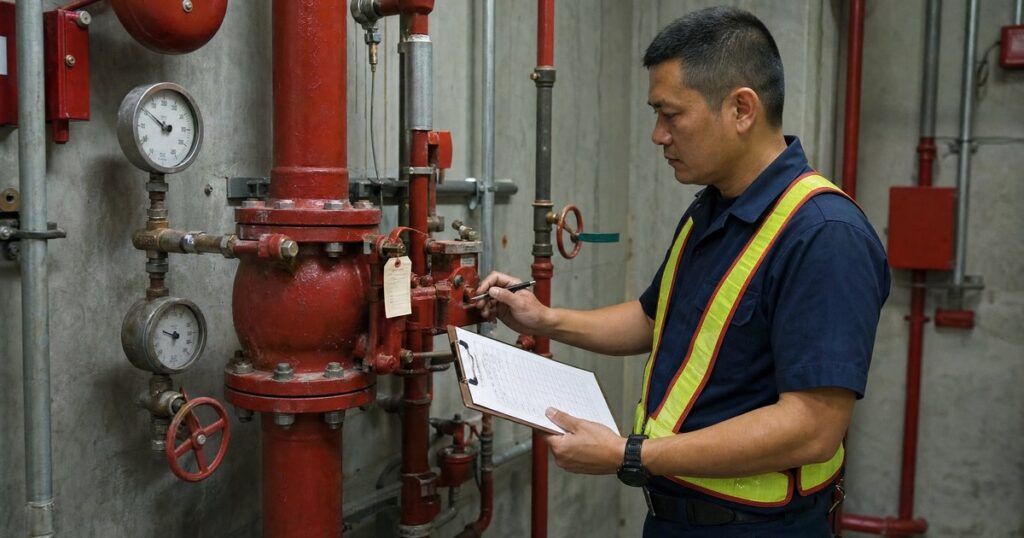
Your property manager gets the call at 9 a.m.: the city inspector is at the building next door, and the fire alarm panel is dark. Nobody can say when it went out. The circuit breakers aren’t responding right, one of the fire doors won’t latch, and now there’s a decision to make before lunch.
That decision has a name in the fire code, and it is not optional. When a required fire alarm or sprinkler system goes out of service in an occupied building, the code gives you exactly two lawful paths: evacuate the affected area, or put a fire watch on it. A broken alarm does not, by itself, force you to empty the building — but it does start a clock, and once that clock runs out, staying occupied without a watch is a code violation, not a judgment call.
Short answer: A dead fire alarm does not automatically require evacuation. Under the fire and life safety codes most jurisdictions adopt, an alarm system out of service more than 4 hours in a 24-hour period in an occupied building triggers a choice: evacuate, or place an approved fire watch. The authority having jurisdiction (AHJ) decides which one applies to your building, and most occupied commercial buildings choose the watch because closing down costs more than staffing one.
A Milwaukee Alarm and Electrical Failure Shows What “Immediate Threat” Looks Like
Two apartment buildings in Milwaukee were emptied this week after a city inspector found the electrical system and the fire alarm system both compromised. The Milwaukee Department of Neighborhood Services said the circuit breakers were no longer functioning correctly, consistent with tampering, and the buildings also had problems with the fire doors. Between the dead alarm system, the compromised electrical panel, and doors that would not do their job in a fire, the department determined there was an immediate threat to health and safety and posted a placard ordering the residents out. At least 40 people were displaced with almost no notice.
That is the outcome when the deficiencies stack: no working detection, an electrical system that could itself start a fire, and failed compartmentation at the doors. It is worth separating the pieces, because a single dead fire alarm — without the electrical and door failures — does not automatically produce that result. It produces a fire watch decision instead, and understanding that decision is what keeps a routine alarm outage from turning into a placard.
Notice what actually triggered the evacuation order: not the alarm outage alone, but the combination. A dead alarm with everything else intact is a fire watch situation almost everywhere it comes up. Add a compromised electrical system that could ignite on its own, and add fire doors that will not compartmentalize smoke and flame if something does start, and the inspector no longer has a fire watch option on the table — there is nothing left for a patrol to protect against, because the building itself cannot contain a fire if one starts. That is the practical line between “staff a watch” and “get everyone out”: can a guard’s detection and notification actually substitute for what is broken, or is the building’s basic ability to compartmentalize and survive a fire also gone.
How Long Does a Fire Watch Last During an Alarm Outage?
A fire watch during an alarm outage lasts exactly as long as the impairment does — from the moment the system goes out of service until a qualified technician verifies it is restored and the AHJ or fire department is notified of the restoration. There is no fixed cap in the code; a same-day panel swap might need four or five hours of coverage, while a full rewire after storm damage can run the watch for days or weeks.
That open-ended duration is exactly why the up-front decision matters more than it looks. A property that staffs a fire watch expecting a two-hour fix, and then discovers the vendor needs a specialty part that takes three days to ship, has to keep the watch running the entire time — the code does not grant a grace period once you are past the original estimate. Building owners who plan for the realistic repair window, not the optimistic one, avoid a mid-impairment scramble to find coverage. This is also the point in the process to revisit the evacuate-or-watch decision itself: an outage that was reasonably handled with a watch at 8 hours can look different at 8 days, and the AHJ retains the authority to change the answer if the risk profile shifts.
Restoration is not just “the panel lights up again.” The technician has to test the system, confirm monitoring is receiving signals correctly, and document the date and time of restoration. Only after that verification, communicated to the AHJ and the monitoring company, does the fire watch requirement end. Pulling the guard the moment the panel appears to reboot — before the test and the paperwork — is a common and expensive mistake if anything goes wrong in the hours after.
NFPA 72 Puts a Clock on a Dead Fire Alarm, Not an Automatic Evacuation Order
NFPA 72, the National Fire Alarm and Signaling Code, governs how alarm systems are designed, tested, and maintained, and it requires a documented process the moment a system is impaired: notify the people responsible for the building, tag the dead system so nobody assumes it is working, and get it repaired. NFPA 72 itself does not order a fire watch or an evacuation. It defines the impairment. The response comes from whatever fire and life safety code your jurisdiction has adopted, working alongside NFPA 72’s impairment process.
The rule that actually produces a decision is the one most property managers have heard secondhand: an alarm system out of service more than 4 hours in a 24-hour period, in a building that stays occupied, triggers the evacuate-or-watch choice under the common adopted code language. That 4-hour clock starts running the moment the system goes out, not when someone notices. A planned outage for testing or panel replacement carries the same obligation — notify the AHJ and the monitoring company, and expect a fire watch to be required if the building stays occupied overnight.
Two things matter here that get lost in translation. First, the AHJ interprets the details for your specific building and adopted code edition — this is not a single nationwide number engraved in stone, it is a common threshold that local adoption can modify. Second, central-station monitoring is not a substitute. A monitoring company only reports signals from a working system; when the panel is dark, there is no signal for anyone to monitor, which is exactly why the code demands a human replacement for the machine.
The Code Gives You Two Options: Evacuate the Space or Provide an Approved Fire Watch
Once a required protection system is out of service beyond what the adopted code tolerates, the fork is the same regardless of which code path applies. Under the International Fire Code’s impairment section, where adopted, the fire code official can require evacuation or an approved fire watch. NFPA 101, the Life Safety Code, carries a comparable evacuate-or-watch provision for occupied buildings in many adoptions. Facilities certified under CMS conditions of participation face the identical fork with survey consequences attached, and insurance carriers layer their own impairment-program expectations on top, usually pointing toward a watch during the outage.
Nobody gets to pick the cheaper option quietly. The code language says approved, which means the AHJ can reject a fire watch plan that does not hold up on paper, and can order evacuation where the risk is too high for a patrol to manage — a hospital ward with non-ambulatory patients behaves differently than a warehouse with three employees on a day shift.
Four factors drive which way the AHJ leans:
- Occupancy — who is inside, and whether they can actually get out on their own if something goes wrong.
- Duration — a two-hour panel repair is a different conversation than a six-week rewire.
- Exposure — what the dead system was protecting: sleeping occupants, a server room, a loading dock.
- Operations — what closing the building or the affected floor would actually cost the owner or tenant.
In practice, occupied commercial buildings choose the fire watch far more often than they evacuate, because emptying a functioning building costs more than staffing a patrol with a documented log. Evacuation stays the right call for short outages in buildings that can genuinely empty without harm, and it becomes the only call when the deficiencies compound — as they did in Milwaukee, where a dead alarm sat alongside a compromised electrical system and failed fire doors.
What a Fire Watch Guard Actually Does During an Alarm Outage
With the alarm system down, the building has no automatic detection. A fire watch does not repair that gap with a clipboard sitting at the front desk — it replaces the machine with a person performing the machine’s job. That means:
- Patrol — continuous rounds covering every area the dead system was protecting, on a schedule the AHJ or the impairment plan specifies.
- Detect — the guard is functioning as the smoke detector. That means actively checking for smoke, heat, and hazard conditions on every round, not walking past them.
- Notify — a working phone or radio at all times, with the authority and the pre-briefed procedure to call the fire department and alert occupants if something is found, per the site’s notification plan.
- Log — a timestamped record of every round, every hazard checked, and every notification made. This is the record the AHJ and the insurer will ask for once the outage ends.
The guard’s authority is bounded by what the AHJ and the impairment plan approved. A fire watch does not substitute for a working sprinkler system’s suppression capability, and it does not authorize the guard to perform repairs on the alarm panel or the electrical system. Its job is detection, notification, and documentation — not fixing the underlying problem.
What a Property Manager Should Do the Moment an Alarm Fails
The sequence matters more than any single step in isolation. Scope the outage precisely before choosing a path — a single zone down is not the same decision as the whole panel dark. Propose the fire watch (or evacuation) plan through the building’s impairment program, in writing, rather than deciding informally and hoping nobody asks. Get the AHJ’s acceptance of that plan in writing before treating it as settled. Staff the watch exactly to the plan the AHJ accepted, not a lighter version of it. And revisit the decision if the outage grows or stretches longer than expected — a repair that turns from hours into weeks reopens the question, and the AHJ can change the answer.
Keep a documentation packet the whole time the system is down. At minimum:
- The time the system went out of service and who was notified.
- The monitoring company’s notification record confirming they know the system is down.
- A timestamped patrol log for every round of the watch, with hazards checked and any findings noted.
- The AHJ’s order or written approval of the plan, if one was issued.
- The restoration time, the technician who verified it, and confirmation the monitoring company received a live test signal.
If your insurer or the fire marshal asks for the outage record — and after any incident nearby, they will — this packet is the difference between a documented, defensible response and a finding against the building. It is also the record an AHJ will want to see the next time your building has an impairment, so treat it as a permanent part of your fire safety files, not paperwork to discard once the alarm is back on.
A dead fire alarm and a compromised electrical system are not the same failure, even though they can show up on the same inspection report. Treat the alarm outage on its own terms: notify, tag, decide evacuate-or-watch with the AHJ, staff to the accepted plan, and document every round. Handle the electrical and life-safety issues — jammed doors, tampered breakers — as their own separate emergencies, because those are the failures that turn an alarm outage into a placard.
Getting the right fire watch staffed correctly, on short notice, is the entire reason this decision does not have to become a crisis. The Fast Fire Watch Company puts certified guards on site in under 3 hours, 24/7, anywhere in the country, once your impairment plan calls for a watch. If your building is in Wisconsin and you need to understand the state’s specific fire watch and AHJ requirements before your alarm outage clock runs out, see our Wisconsin fire watch requirements page. Call 1-800-899-7524 the moment your alarm goes dark — certified guards on site in under 3 hours, 24/7.